

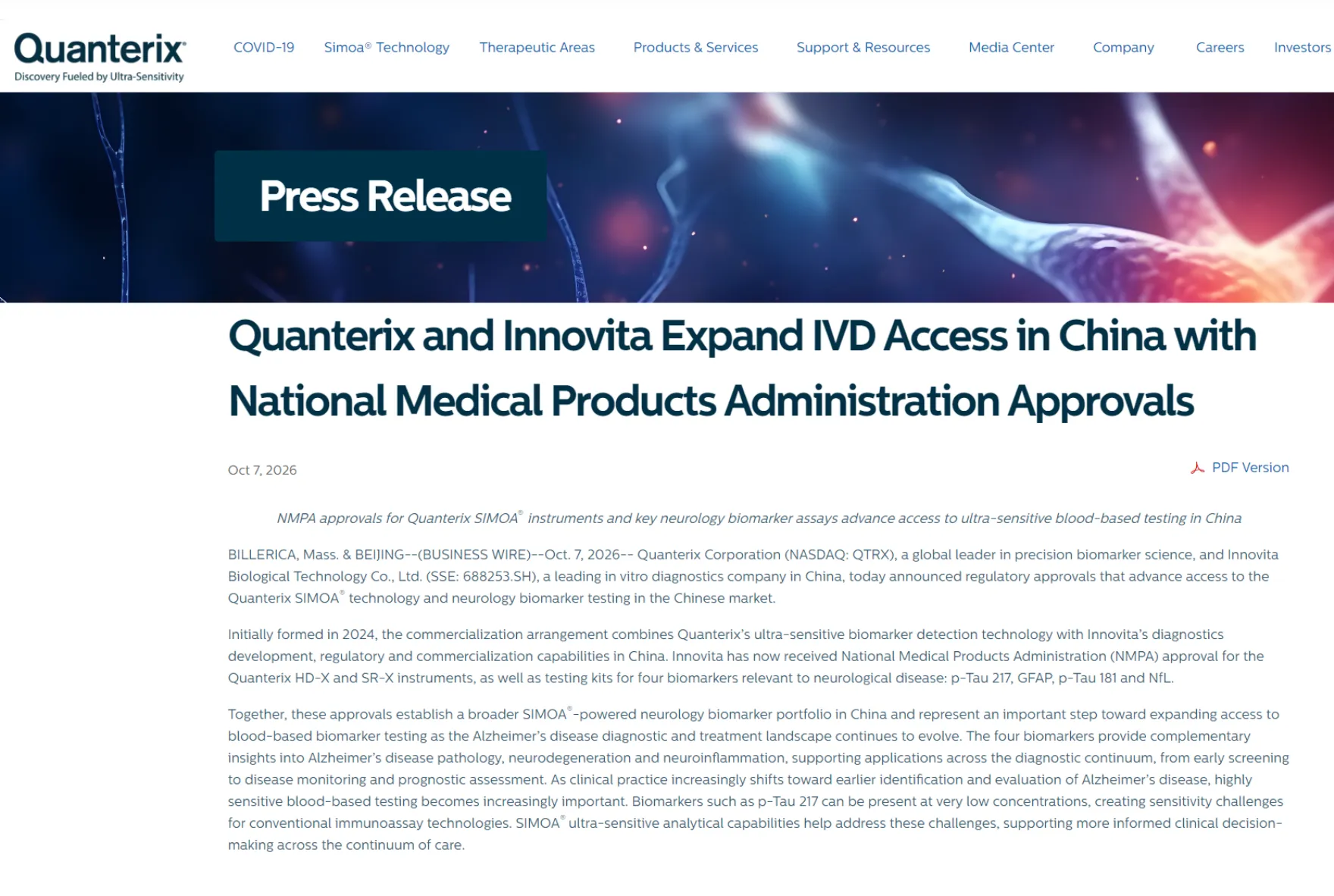
BEIJING, China — Oct. 7, 2026 — Quanterix (NASDAQ: QTRX), a global leader in ultrasensitive biomarker detection, has announced a significant milestone in its strategic collaboration with Innovita Biological Technology Co., Ltd. (INNOVITA; SSE STAR Market: 688253), as detailed in its latest official press release.
Building on their strategic collaboration around Simoa® technology, INNOVITA has successfully obtained National Medical Products Administration (NMPA) registration approvals for the Quanterix HD-X and SR-X single-molecule immunoassay analyzers, as well as four reagent kits targeting key neurological disease biomarkers: p-Tau 217, GFAP, p-Tau 181, and NfL. In its announcement, Quanterix expressed strong recognition of INNOVITA’s ability to translate regulatory approvals into commercial opportunities in the Chinese market.
Advancing Access to Advanced Neurological Biomarker Testing in China
Commenting on the recent progress in the strategic collaboration, Ms. Zhang Xiujie, GM of Innovita, said:
“Supporting the national strategy for the prevention and control of age-related diseases means translating internationally advanced ultrasensitive biomarker technologies into medical device products that are accessible to clinical practice in China. This is a core objective of our strategic collaboration with Quanterix. Alzheimer’s disease often develops silently, and intervention may come too late when noticeable cognitive decline emerges. We hope to advance the clinical application of Simoa® technology to support earlier and more accurate clinical decision-making for Alzheimer’s disease, enabling more patients and families to benefit.”
Everett Cunningham, CEO of Quanterix, also commented:
“Alzheimer’s disease places a significant burden on patients and their families. Earlier and more accessible testing can help clinicians make more informed diagnostic decisions. Our commercial collaboration with INNOVITA represents an important step toward expanding access to ultrasensitive protein biomarker testing globally. By working with a strong regional partner, we are advancing the adoption of Simoa® technology in China’s large and influential in vitro diagnostics market.”
Addressing the Growing Need for Early Alzheimer’s Disease Detection
Alzheimer’s disease (AD) is the most common form of dementia in older adults. Its insidious onset and gradual progression pose a serious threat to the health and well-being of aging populations. As China’s population continues to age, the number of people living with AD and related dementias has approached 17 million. The disease not only significantly affects patients’ quality of life but also places considerable demands on family caregivers and the public healthcare system.Because the disease can progress unnoticed for an extended period, many patients are not diagnosed until the middle stage, potentially missing opportunities for earlier intervention and increasing the burden on families and society.
In response, 15 government departments, led by the National Health Commission of China, jointly issued the National Action Plan for Addressing Population Aging and Dementia (2024–2030). The plan calls for the establishment of a comprehensive system covering screening, intervention, diagnosis, rehabilitation, and full-course management of age-related dementia. It emphasizes early screening for cognitive impairment and improvements in the standardization of diagnosis and treatment. The plan also sets targets for 2030, including achieving an initial cognitive function screening rate of 80% or higher among older adults receiving health management services, and an intervention guidance rate of at least 80% among cognitively normal individuals at risk of cognitive impairment, as well as a dementia diagnosis rate of at least 50% among people suspected of having cognitive impairment.
Meanwhile, China’s National Healthcare Security Administration issued the Guidelines for the Establishment of Medical Service Pricing Items for Testing Services (Trial), incorporating core AD blood biomarkers—including Tau protein, beta-amyloid (Aβ), neurofilament light chain (NfL), and glial fibrillary acidic protein (GFAP)—into the national unified medical testing fee-item framework. This policy development provides an important pathway for blood biomarker testing to be incorporated into medical institutions at different levels and establishes a policy foundation for broader clinical adoption.
Four Approved Biomarker Assays Supporting Clinical Assessment Across the AD Care Pathway
According to the Expert Consensus on Blood-Based Biomarkers for Alzheimer’s Disease and Their Testing Technologies (2026 Edition) and the revised 2024 criteria of the National Institute on Aging and the Alzheimer’s Association (NIA-AA), the four newly approved reagent kits target key biomarkers relevant to Alzheimer’s disease assessment. Among these, p-Tau 217 and p-Tau 181 are core AD-related biomarkers used in early detection and screening. NfL is an indicator of neuroaxonal injury, while GFAP is associated with glial activation. These biomarkers can support assessment of disease status and prognosis in the appropriate clinical context. Powered by Quanterix’s Simoa® single-molecule immunoassay technology, the assays enable ultrasensitive quantification of target biomarkers at femtogram-per-milliliter (fg/mL) levels. Their detection limits are substantially lower than those of conventional immunoassay methods, with sensitivity reported to be approximately 1,000 times higher. This capability enables the detection of pathological signals associated with the early clinical stages of Alzheimer’s disease.
Together, these assays can provide reliable laboratory evidence to support early identification of individuals at elevated risk of cognitive impairment, AD diagnosis and differential diagnosis, disease monitoring, and prognostic assessment. They are designed to address clinical needs across multiple settings, including memory clinics, neurology departments, and geriatric medicine.
Expanding the Simoa® Portfolio and Future Collaboration
In addition to the four reagent kits for p-Tau 217, GFAP, p-Tau 181, and NfL covered by this approval milestone, INNOVITA will continue to advance the development of additional neurological disease biomarker assays. Through its strategic collaboration with Quanterix, the company also plans to expand into infectious disease applications, further broadening the range of tests available on the Simoa® platform in China. By combining ultrasensitive biomarker detection with INNOVITA’s regulatory, commercialization, and market development capabilities in China, the collaboration aims to provide clinical laboratories and healthcare professionals with more comprehensive ultrasensitive testing solutions and support the wider clinical application of advanced biomarker technologies.
Source: Innovita Biological Technology Co., Ltd.